How AI Helps Production Planners Make Better Decisions
Artificial intelligence is increasingly becoming part of modern production planning. As supply chains grow more complex and production environments become more dynamic, organizations are looking for ways to support planners with better insights and faster decision-making.
In this context, AI is often misunderstood as a technology that replaces planners. In reality, its most valuable role is quite different. AI helps planners analyze complex situations, evaluate more alternatives, and make more informed operational decisions.
Production planning has always relied on a combination of experience, data, and operational judgment. AI simply strengthens this process by allowing teams to analyze more data, anticipate disruptions earlier, and evaluate multiple planning scenarios more efficiently.
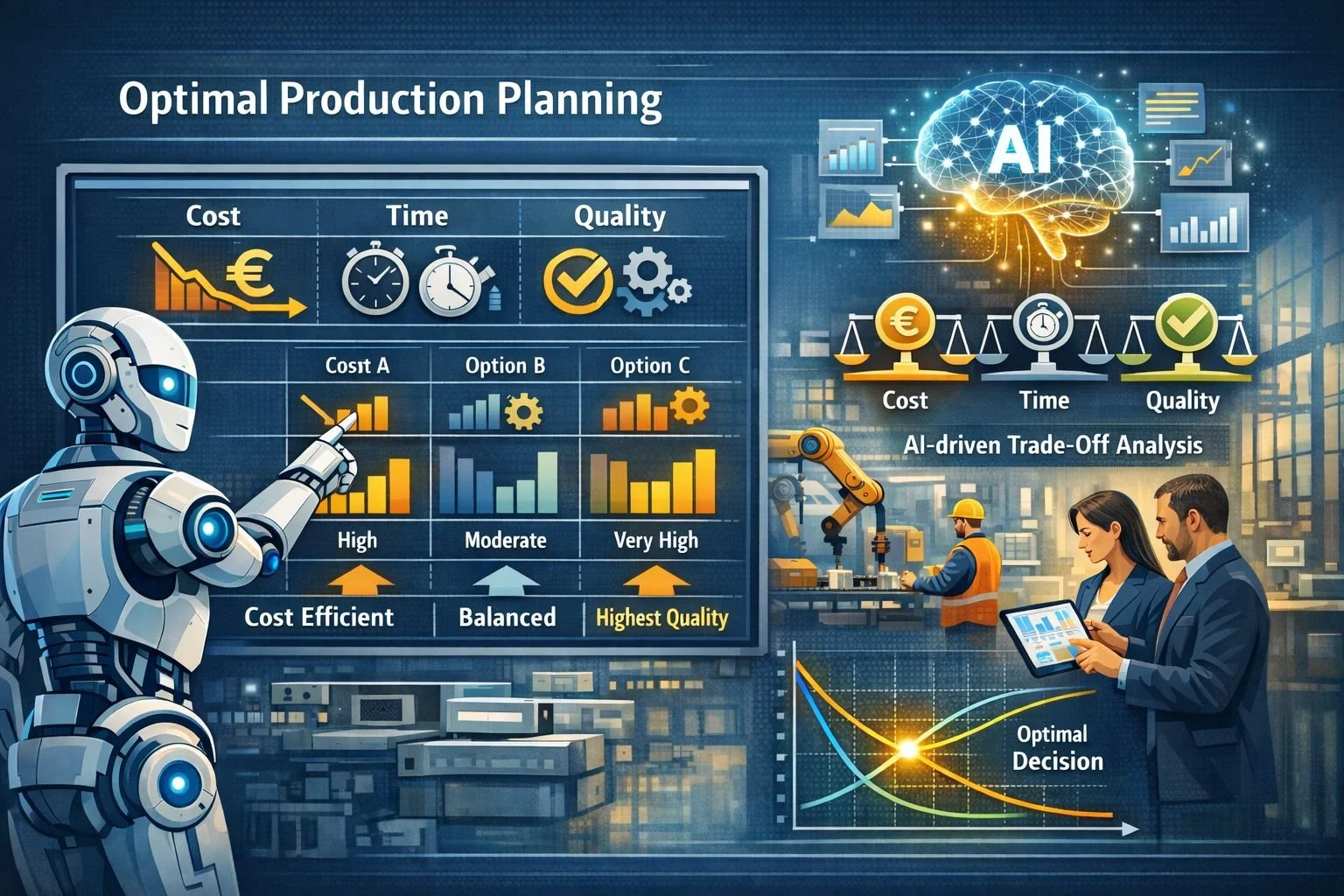
Artificial intelligence is transforming production planning in manufacturing, but its real value lies in supporting planners with decision optimization rather than replacing human expertise.
Understanding Where AI Adds Value in Production Planning
When organizations begin exploring AI in production planning, they often start with analytics tools that improve transparency across operations. These systems provide insights into delivery performance, inventory levels, machine utilization, and production delays.
Improved visibility is valuable because it allows teams to understand what is happening across the production system and identify issues earlier. However, planning challenges rarely arise from a lack of visibility alone. They usually emerge from the need to make complex decisions while balancing multiple constraints such as machine capacities, delivery commitments, and inventory targets.
This is where AI can play a meaningful role. By evaluating large numbers of planning alternatives, AI systems help planners explore options that would be difficult to analyze manually.
The Three Layers of AI in Production Planning
AI in production planning typically evolves through three stages. Understanding these layers helps organizations recognize their current capabilities and identify where the next opportunity lies.
1. Visibility: Operational Transparency Through Analytics
The first stage focuses on visibility and operational analytics. Organizations implement dashboards, KPI monitoring systems, and alerting mechanisms that provide real-time insights into production performance.
These tools allow planners and operations teams to better understand factors such as order delays, production bottlenecks, and capacity utilization.
At this stage, the system answers an important question:
What is currently happening in the production environment?
This visibility improves coordination across teams and allows organizations to react faster to operational issues.
2. Prediction: Anticipating Future Risks and Changes
The second stage introduces predictive capabilities. Machine learning models can analyze historical data and identify patterns that help forecast demand, estimate delivery delays, or highlight potential capacity risks.
With predictive insights, planners gain a better understanding of what may happen in the near future. This foresight allows organizations to prepare earlier for disruptions and adjust plans proactively.
The key question addressed in this stage becomes:
What is likely to happen next?
While prediction improves planning awareness, it still does not automatically determine the best operational decision.
3. Optimization: Supporting Complex Planning Decisions
The third stage is where AI begins to create significant operational value.
At this level, AI supports planners in evaluating complex trade-offs and alternative planning scenarios. Examples include sequencing production orders under machine constraints, allocating capacity across multiple plants, or balancing inventory levels against delivery reliability.
Instead of evaluating only a few planning alternatives manually, planners can explore thousands of possible scenarios with the support of AI-driven optimization.
In this role, AI acts as a decision support system rather than a replacement for planners. The planner remains responsible for selecting the final strategy, but AI helps identify promising options much faster.
Why AI Strengthens the Role of Production Planners
One of the most important insights in modern manufacturing is that AI works best when combined with human expertise.
Algorithms are highly effective at processing large datasets and evaluating complex combinations of constraints. However, planners contribute contextual knowledge, operational understanding, and strategic judgment.
When these capabilities are combined, organizations gain a powerful advantage. Planners can respond faster to disruptions, evaluate more alternatives, and maintain stability in complex production environments.
As a result, planners who use AI as part of their workflow often outperform teams that rely solely on manual planning approaches.
What This Means for Production Organizations
For many organizations, the opportunity is not simply introducing AI into existing planning systems. The real opportunity lies in integrating data, analytics, and decision support into planning processes in a meaningful way.
Companies that successfully combine these elements often see improvements in areas such as delivery reliability, inventory efficiency, and production stability.
Achieving these results requires a clear understanding of how data flows through planning processes and how decision-making can be supported by analytics and optimization technologies.
Key Takeaways
Artificial intelligence is becoming an important capability in modern production planning. While analytics and predictive models provide valuable insights, the greatest operational impact appears when AI supports planners in evaluating complex decisions.
Organizations that combine human expertise with AI-driven decision support can respond faster to disruptions, evaluate more alternatives, and maintain more stable production systems.
Rather than replacing planners, AI strengthens their ability to navigate increasingly complex manufacturing environments.
The Role of AI in the Future of Production Planning
As production environments continue to evolve, organizations are exploring how advanced analytics, machine learning, and optimization technologies can strengthen planning processes.
At Stremler AG, we often see that the most successful implementations focus on augmenting planners with better decision intelligence rather than replacing human expertise.
When data, analytics, and operational knowledge are integrated effectively, production teams gain the ability to make more informed decisions and maintain stability across increasingly complex production systems.