Connecting Lean and Continuous Improvement
Operational Excellence is one of the most discussed topics in modern organizations. Teams introduce Lean initiatives, launch improvement programs, and track performance through dashboards. These efforts bring valuable progress, yet many organizations still search for a way to translate these activities into lasting operational performance.
The key lies in understanding how Operational Excellence (OPEX), Lean Management, and Continuous Improvement (CIP) work together. Each concept plays a different role. When they are clearly structured and aligned, they create a powerful system that supports consistent performance and sustainable improvement.
The illustration below shows how these elements come together within a complete Operational Excellence framework.
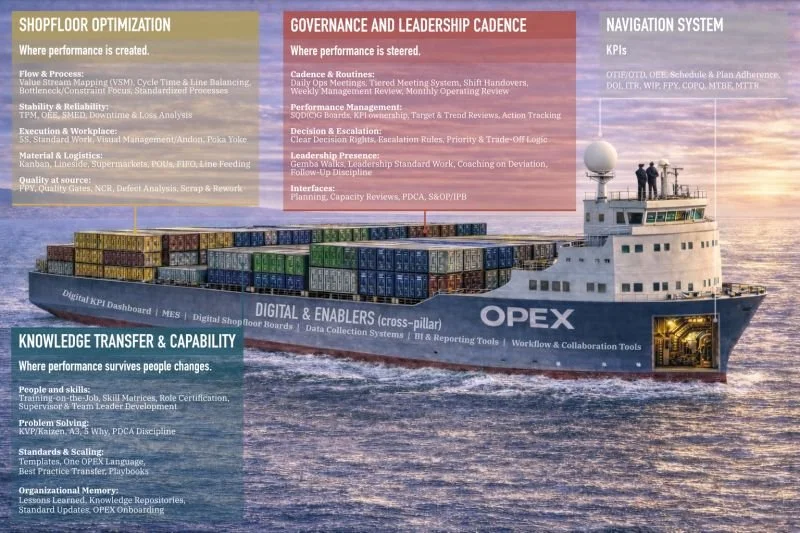
Operational Excellence system showing how Lean Management, Continuous Improvement, leadership governance, and digital enablers connect to drive sustainable operational performance.
Why clarity around OPEX, Lean, and Continuous Improvement matters
Many organizations describe their efforts as an Operational Excellence initiative. In practice, this often includes activities such as Lean workshops, improvement projects, KPI dashboards, and continuous improvement programs.
Each of these initiatives contributes significant value. They strengthen processes, encourage learning, and enhance transparency. At the same time, each represents a component of operational excellence, rather than the entire system.
Operational Excellence becomes truly powerful when these elements connect into a structured operating model that guides daily execution across the organization.
Understanding the role of each concept creates clarity and enables teams to move from individual initiatives toward a cohesive performance system.
Lean Management: Improving processes on the shop floor
Lean Management focuses on process performance and operational flow. It provides the practical methods that help teams improve how work happens on the shop floor.
Lean initiatives typically concentrate on:
Reducing waste in processes
Stabilizing workflows and production flow
Increasing efficiency and reliability
Applying structured improvement methods such as 5S, TPM, SMED, Value Stream Mapping (VSM), SQDC, and the 5 Whys
Through these approaches, Lean strengthens the operational backbone of an organization. Teams gain visibility into processes, identify improvement opportunities, and implement solutions that enhance productivity and quality.
Lean therefore represents the practical improvement engine within operations.
Continuous Improvement (CIP): Building the improvement mindset
Continuous Improvement Programs (CIP) focus on behavior, learning, and everyday problem solving. The goal is to create a culture in which improvement becomes a natural part of daily work.
CIP encourages teams to:
Recognize and understand operational challenges
Solve problems through structured methods
Learn through short improvement cycles
Strengthen collaboration and shared ownership
When teams embrace continuous improvement, small improvements accumulate into meaningful progress. The organization builds a culture where learning and refinement become part of everyday routines.
CIP therefore strengthens how people think, collaborate, and evolve within the organization.
Operational Excellence (OPEX): The system that connects everything
Operational Excellence represents the organizational system that brings Lean and Continuous Improvement together.
Rather than focusing on isolated initiatives, OPEX creates a framework that connects:
Shopfloor activities
Leadership routines
Performance management
Decision structures
Governance and accountability
Organizational learning
With this structure in place, improvements become embedded in daily operations. Teams understand priorities, leaders reinforce performance rhythms, and decisions align with strategic objectives.
Operational Excellence transforms improvement efforts into a repeatable and scalable operating system for the organization.
A simple way to recognize a mature Operational Excellence system
Organizations often begin their journey through Lean initiatives or improvement programs. Over time, the focus shifts toward creating a consistent operating rhythm that supports performance across the entire organization.
When Lean and Continuous Improvement operate within a clear OPEX framework, improvements become part of the organization’s natural cadence. Processes evolve continuously, teams collaborate effectively, and operational performance strengthens over time.
The result is a system where strategy translates smoothly into daily execution.
How Lean, CIP, and OPEX create sustained performance
Each concept plays an important role within a high-performing organization.
Lean strengthens process performance.
Continuous Improvement strengthens behavior and learning.
Operational Excellence strengthens how the organization operates as a whole.
Together they create an environment where improvement becomes structured, consistent, and scalable. Teams move from isolated initiatives toward a cohesive operating model that supports long-term operational success.
Organizations that align these elements gain a powerful advantage: a performance system that remains strong through growth, leadership transitions, and changing market conditions.
Turning operational strategy into daily execution
Operational Excellence ultimately connects strategy with everyday operations. It provides the structure that helps teams maintain clarity, reinforce accountability, and sustain progress.
When organizations align Lean methods, continuous improvement habits, and operational governance, they create a system where performance evolves naturally and consistently.
This is the foundation of modern Operational Excellence.
Explore how Operational Excellence systems work in practice
Organizations looking to strengthen their operational structure often benefit from seeing how these concepts translate into real operational workflows and decision processes.
At STREMLER AG, we work closely with organizations to transform improvement initiatives into structured operational excellence systems that support sustainable performance.
You can explore how these concepts apply in practice by selecting the Request Demo option above to see how Operational Excellence systems can support your organization’s daily execution.