
Physical AI in Manufacturing: Why Data, Planning, and Process Foundations Matter
My first experience with artificial intelligence was a chatbot running on an Atari. I was maybe ten years old, sitting in front of an Atari 1040 ST, talking to ELIZA, a simple program originally developed in the 1960s.
ELIZA did not understand anything. It simply mirrored sentences using pattern matching. But at that age, it felt like magic.
The question that fascinated me then, whether machines could understand the real world, is the same question the technology industry is now answering at scale.
And today, that answer is becoming reality.
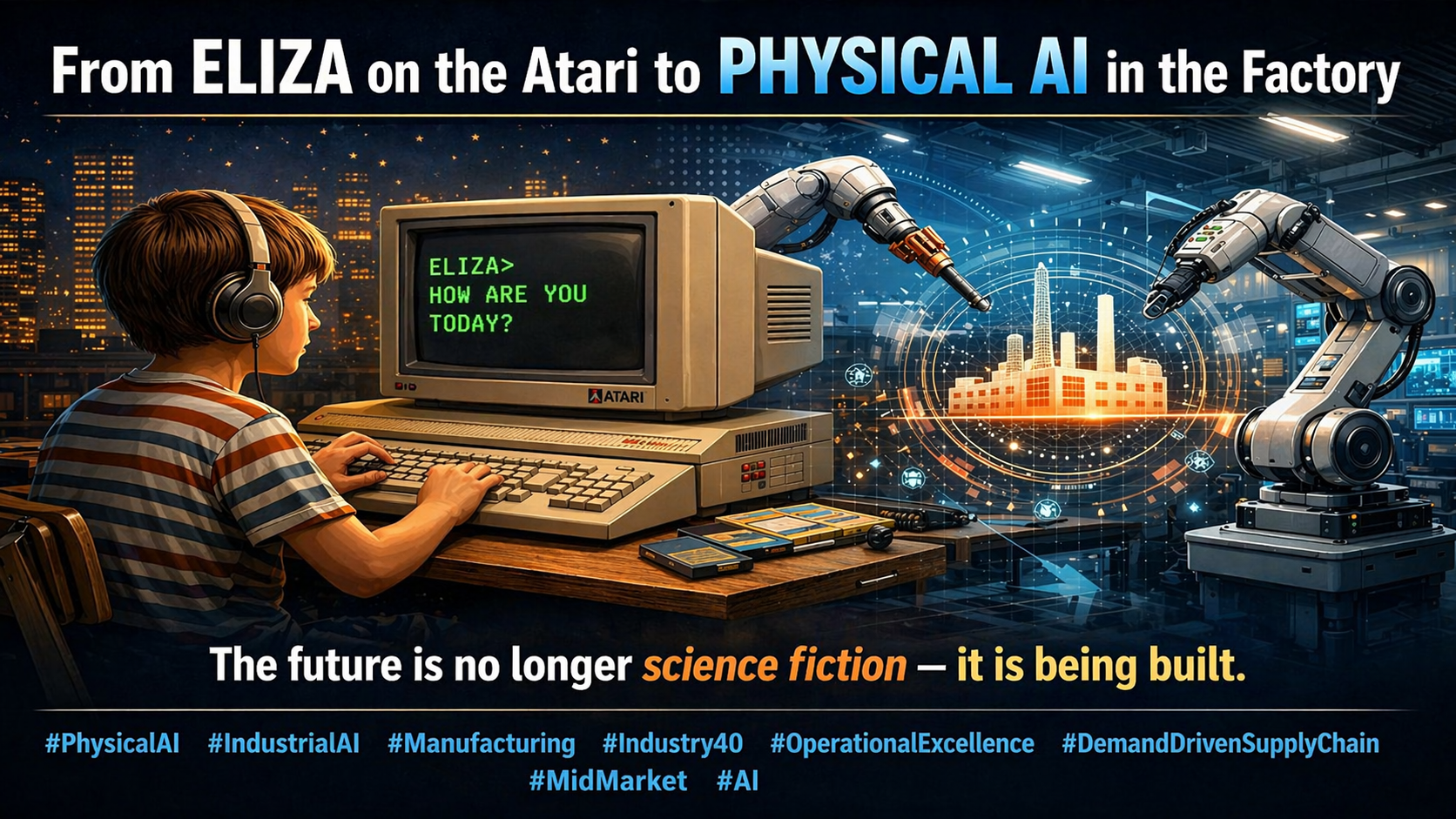
From early conversational AI to real-time industrial intelligence: Physical AI is transforming manufacturing operations.
What Is Physical AI in Manufacturing?
Physical AI in manufacturing describes the integration of artificial intelligence directly into physical production systems. It enables machines, processes, and supply chains to perceive, decide, and act in real time.
Unlike digital AI, which operates on screens through text and images, physical AI interacts with the real world. It processes sensor data, adapts production plans dynamically, and responds to disruptions as they occur.
This shift marks a fundamental transition. AI is no longer just a tool for analysis or automation. It is becoming an operational layer embedded into industrial environments.
From Planning Experience to Machine Intelligence
I recently spoke with a production planner at a mid-sized manufacturer. I asked how he prioritizes orders when the plan breaks down, when a machine fails, a supplier is late, or an urgent request comes in.
He smiled and said, “I just know.”
That knowledge is built over decades. It includes understanding which customers tolerate delays, which machines perform differently under certain conditions, and how materials behave depending on the environment.
None of this is documented. None of it exists in ERP systems. It lives entirely in the heads of experienced people.
This is exactly where physical AI in manufacturing begins. It aims to capture, structure, and operationalize this kind of knowledge and make it available in real time.
Why Physical AI Is No Longer a Future Topic
The conversation around AI in manufacturing is shifting quickly. Industry leaders are no longer talking about experimentation. They are talking about execution.
The focus is moving away from AI as a content generator and toward AI as a production capability. Instead of generating text or images, AI is increasingly used to control machines, optimize processes, and connect digital planning with physical execution.
This is where physical AI becomes critical. It creates a closed loop between data, decisions, and actions on the shop floor.
But while the vision is clear, the reality looks very different.
The Gap Between Vision and Reality
Most manufacturers are still far from implementing physical AI effectively.
The challenge is not the availability of technology. It is the lack of a solid operational and data foundation.
In many organizations, critical knowledge remains undocumented. Data is fragmented across systems. ERP systems contain orders, while production systems capture machine states, but these elements are rarely connected in real time.
At the same time, master data such as bills of materials, routing plans, and cycle times is often incomplete or outdated. Without reliable data, AI cannot make reliable decisions.
This creates a significant gap between ambition and execution.
Why the Foundation Matters More Than the Technology
One of the most common misconceptions is that AI can solve structural problems in operations.
In reality, AI amplifies the existing system. If processes are inefficient or data is unreliable, AI will scale those issues rather than fix them.
This is why physical AI in manufacturing is not just a technology initiative. It is an operational capability that depends on process discipline, data quality, and system integration.
Operational excellence and digital excellence are not separate efforts. They reinforce each other. Stable processes create the conditions for AI to perform, while AI enhances those processes with speed and intelligence.
The Role of Demand-Driven Supply Chains
The shift toward demand-driven supply chains makes this even more urgent.
Customer expectations have changed. Smaller batch sizes, shorter delivery times, and higher variability are now the norm. Traditional planning approaches based on fixed schedules and assumptions are no longer sufficient.
A demand-driven supply chain requires real-time visibility, adaptive planning, and continuous decision-making. Physical AI provides the capability to support this model, but only if the underlying systems are connected and reliable.
Without that foundation, the concept cannot be executed effectively.
Preparing for Physical AI in Manufacturing
The transition toward physical AI does not start with deploying advanced algorithms. It starts with building the right environment.
Manufacturers need to create a connected planning architecture that integrates demand, capacity, and execution across the value chain. They need systems that provide real-time transparency instead of relying on disconnected spreadsheets and periodic planning cycles.
Equally important is capturing institutional knowledge before it disappears. As experienced planners and engineers retire, their expertise must be documented, structured, and made usable for future systems.
Organizations should also focus on incremental progress. Decision-support systems, scenario simulations, and real-time monitoring are practical starting points. These steps build the foundation for more advanced AI capabilities over time.
Why Starting Now Is Critical
The cost of waiting is increasing rapidly.
AI systems improve through data and operational feedback loops. Companies that invest early in data quality and operational integration will accelerate faster than those that delay. The gap between leaders and followers will not grow linearly. In many industries, it will become exponential.
At the same time, the workforce is changing. Knowledge that has been built over decades is at risk of being lost. Capturing and embedding that knowledge into systems is not optional. It is becoming a requirement for long-term competitiveness.
From Vision to Execution
Physical AI in manufacturing is not about replacing people. It is about enabling better decisions at scale.
It represents a shift from static planning to dynamic, real-time operations. It moves organizations from isolated systems toward connected environments and from reactive problem-solving toward proactive optimization.
But this transformation does not start with AI itself. It starts with the fundamentals.
Clean master data. Standardized processes. Real-time visibility.
These are not optional improvements. They are the prerequisites for everything that follows.
The Real Question for Manufacturers
The question is no longer whether AI will transform manufacturing.
The real question is how organizations can build the foundation that allows AI to work effectively in the real world.
Physical AI is not a distant vision. It is already emerging.
The companies that succeed will not necessarily be the ones that adopt it first. They will be the ones that prepare for it properly.
Preparing Your Operations for Physical AI?
At STREMLER AG, we help manufacturers build the operational and data foundations required for real-time planning, intelligent production control, and demand-driven supply chains.
From production optimization and control towers to digital twins and real-time synchronization, we focus on practical solutions that connect operational reality with intelligent decision-making.
If you want to understand where your organization stands today and what the next realistic steps look like, we would be happy to start a conversation.