Why Demand-Driven Supply Chains Require a New Approach to Data
Supply chains today are operating under increasing volatility.
Demand fluctuates more frequently, constraints shift faster, and planning cycles struggle to keep up. In this environment, the limitation is no longer the availability of data.
It is the ability to use that data at the moment decisions need to be made.
This is where demand-driven supply chains emerge — not as a planning improvement, but as a fundamentally different way of operating.
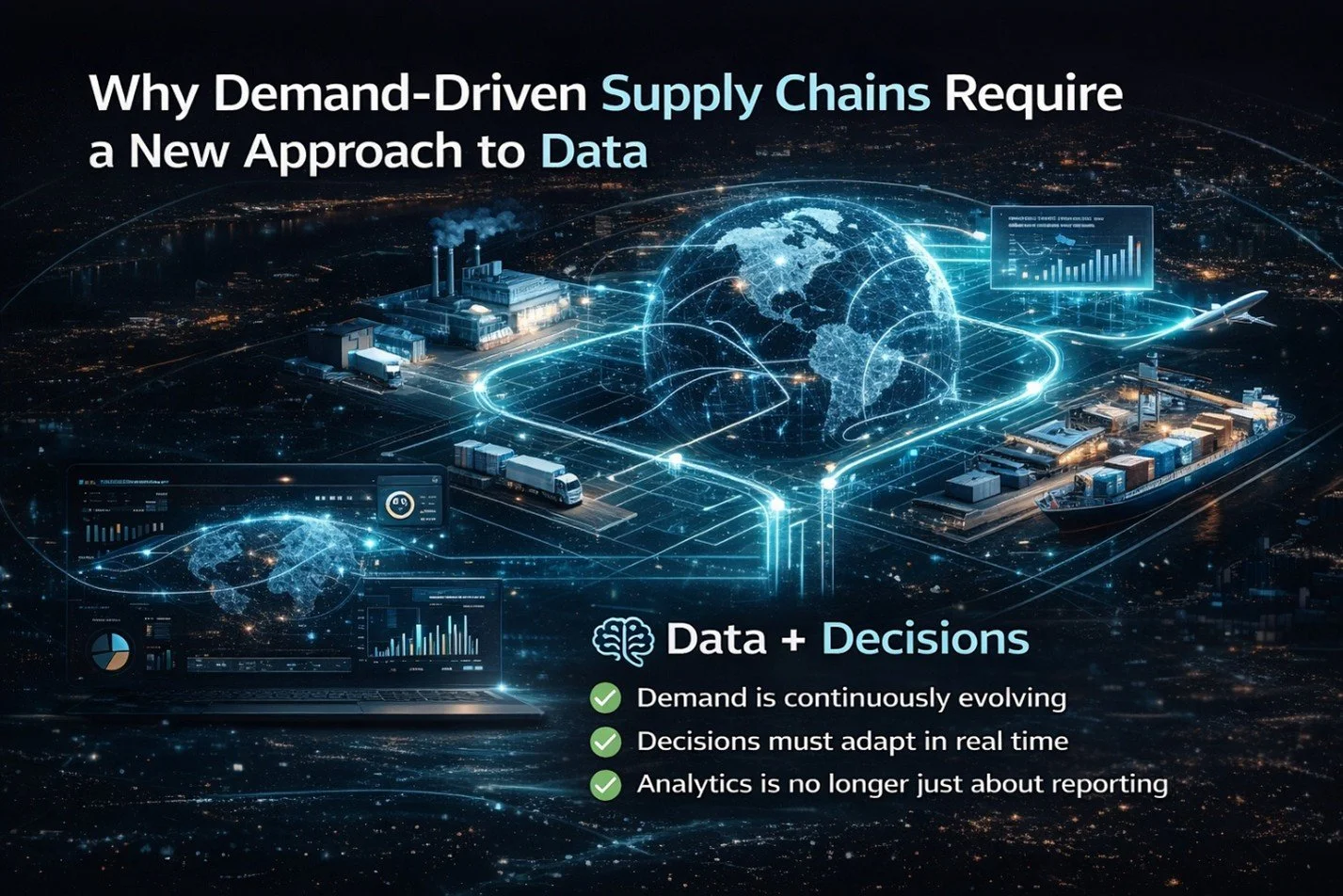
From data to decisions: enabling demand-driven supply chains through real-time analytics and system modeling
Data Analytics in Demand-Driven Supply Chains
Demand-driven supply chains are often described as a shift in planning.
In practice, they represent a shift in how data is structured, interpreted, and used to operate the system.
Instead of periodic planning cycles, decisions are made continuously, as demand, capacity, and constraints evolve in real time. In this context, data analytics is no longer a reporting layer — it becomes part of how the supply chain is controlled.
From Data Availability to System Understanding
Most organizations already possess the required data.
Demand signals, capacity information, and execution feedback exist across ERP, MES, and shopfloor systems. The real challenge lies in fragmentation and lack of alignment between these data sources.
To operate in a demand-driven way, this data must be integrated into a coherent and continuously updated representation of the value chain. Only then can decisions reflect actual system conditions rather than assumptions or averages.
Managing Dynamic Interdependencies
Supply chains are not linear systems. They are networks of interdependent processes, resources, and constraints.
A change in one part of the system inevitably affects others — often in ways that are not immediately visible. This is why local optimization frequently leads to global inefficiencies.
Demand-driven planning requires a system-level perspective, where these interdependencies are understood, continuously evaluated, and aligned across functions.
This is where data analytics moves beyond visibility and becomes a tool for managing system behavior.
From Descriptive Analytics to Operational Control
Traditional analytics provides valuable insight into past performance.
However, in a demand-driven environment, understanding the past is not sufficient. The focus shifts toward representing the current state of the system and evaluating the impact of decisions before they are executed.
This requires analytics to evolve into an operational capability — one that enables real-time system awareness, scenario evaluation under constraints, and informed decision-making.
At this stage, analytics is no longer descriptive.
It becomes operational, predictive, and directly embedded into the decision process.
Connecting Data Analytics to Real-Time Supply Chain Performance
At STREMLER, demand-driven supply chain planning is closely linked to the ability to manage dynamic interdependencies across the entire value chain.
Production, procurement, and distribution are not treated as separate layers, but as interconnected parts of a single system that must be continuously aligned.
This is enabled through the creation of a virtual value stream, where all relevant data is integrated and used to support decision-making in real time.
The result is not just improved visibility, but a deeper level of system understanding — allowing organizations to anticipate bottlenecks, manage risks proactively, and optimize resource utilization continuously.
In this context, data analytics is not a standalone function.
It becomes the foundation for performance management.
What This Looks Like in Practice
A demand-driven system is not defined by individual tools, but by how capabilities are combined into a unified operational layer.
Customer demand signals, real-time simulation, digital twins, and dynamic planning are tightly integrated. Decisions are no longer made in isolation, but within a synchronized system where planning levels are aligned and information flows seamlessly.
This creates an environment where data, models, and decisions continuously interact — enabling faster, more reliable decision-making across the supply chain.
A Practical Example: STREMLER REALTIME TECHNOLOGIES (RTT)
This approach is already implemented in STREMLER REALTIME TECHNOLOGIES (RTT).
RTT integrates data from ERP, MES, and shopfloor systems into a unified system model — effectively creating a Digital Twin of the supply chain.
Within this environment, the system state is continuously updated, and process dependencies and constraints are explicitly represented. This allows system behavior to be simulated under real conditions, and decision scenarios to be evaluated before execution.
From a data analytics perspective, the shift is fundamental.
Data is no longer treated as fragmented inputs for reporting. It becomes a real-time representation of system behavior — enabling decisions that are aligned with operational reality.
This approach is not theoretical.
In realized projects, structuring and using data in this way has led to measurable operational impact. Organizations have achieved performance improvements in the range of 15–20%, alongside lead time reductions of more than 50%.
These results are driven by the ability to operate the supply chain as a demand-driven system, where decisions are continuously aligned with actual conditions across the value chain.
In practice, this enables faster response times, improved transparency across capacity and sequencing, and more reliable availability of materials and resources. The outcome is a supply chain that can meet market requirements with lower inventory levels while improving overall flow and cash efficiency.
Demand-driven supply chains do not require more data.
They require structuring and using data in a way that enables system-level understanding and real-time decision-making.
This is where data analytics becomes operational —and where demand-driven supply chains become executable.
The competitive advantage is no longer in having data.
It is in using data to understand the system — and act at the right moment.
Organizations moving toward demand-driven operations often realize that the challenge is not introducing new tools, but rethinking how data is structured and used within their systems.
If you are working on this shift — from visibility to real-time decision-making — it is worth exchanging perspectives on how this can be implemented effectively in practice.