Many organizations proudly say that they have optimized their supply chain. Production runs smoothly, efficiency metrics look strong, and teams consistently meet their KPIs.
Yet over time a familiar pattern often appears. Warehouses begin to fill faster than expected. Inventory grows even though production is performing well. Delivery times shift, even though each plant operates efficiently on its own.
This phenomenon can be observed across many industries. Even organizations with strong teams, modern systems, and well-established processes encounter it.
The reason lies in the nature of supply chains themselves. They are complex, interconnected systems in which decisions made in one area immediately influence others. When individual processes are optimized locally but coordination across the system remains limited, unintended effects begin to emerge.
This is why many organizations are beginning to rethink how they manage operations. Instead of focusing only on local efficiency, they are looking at the synchronization of the entire production and supply network. When decisions are aligned across plants, processes, and planning horizons, the entire system becomes more stable, responsive, and efficient.
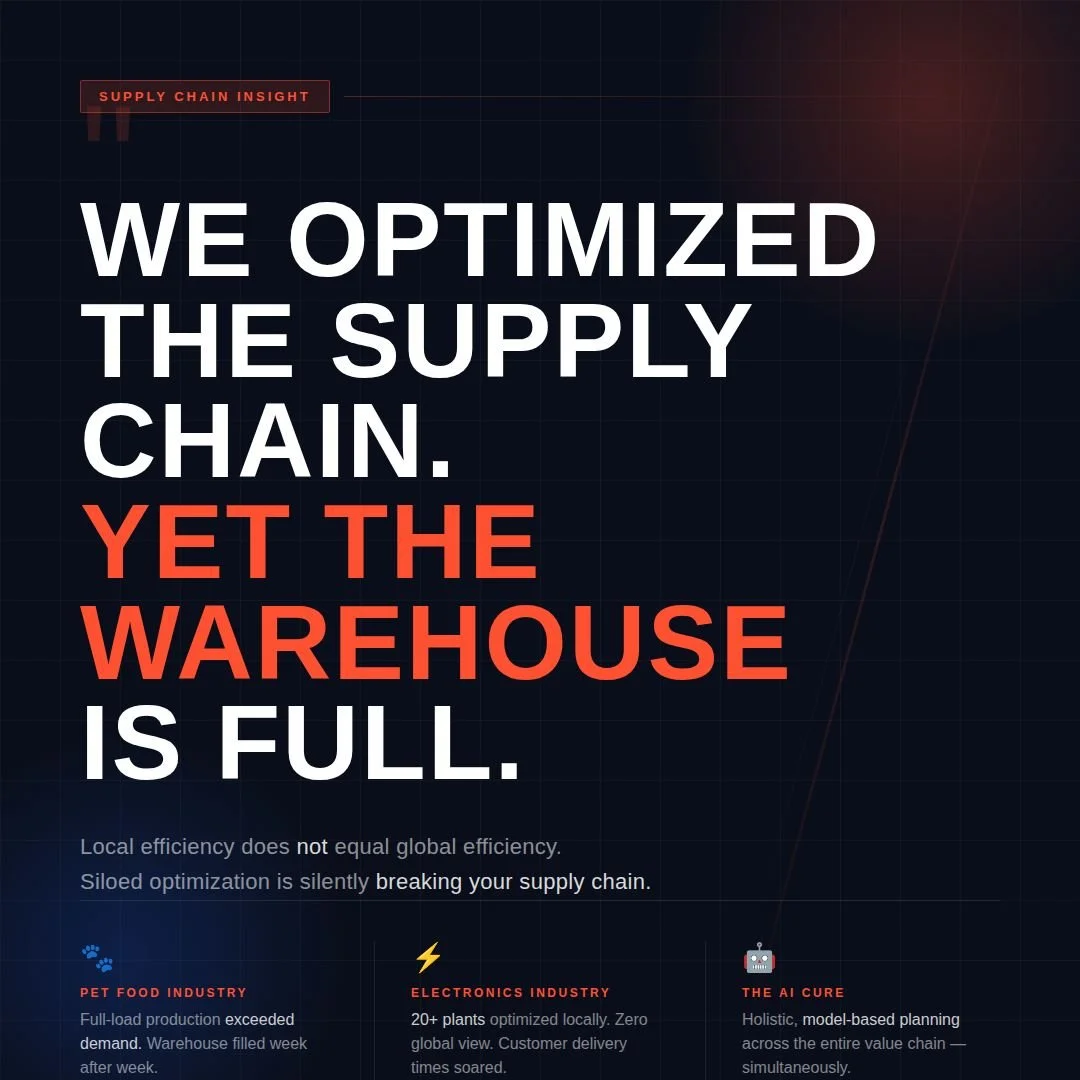
Holistic Supply Chain Optimization with AI, STREMLER AG
Two Industries. Two Different Problems. One Root Cause.
Over the years, I’ve seen the same pattern destroy value in completely different industries.
A Practical Example from the Food Industry
In the food industry, production teams often focus on maximizing capacity utilization. Machines run at full load, production efficiency increases, and operational metrics show strong results. From a production perspective, this approach works very well.
At the same time, the industry operates under specific conditions. Demand can fluctuate significantly, many processes are most efficient in larger production batches, and products often have limited shelf life. These characteristics make planning particularly challenging.
When production output grows faster than actual demand, warehouses gradually begin to fill. What initially looks like operational success can lead to rising inventory levels and increasing complexity in logistics and planning.
In most cases, this situation is not the result of poor performance. On the contrary, every team is doing its job well and meeting its targets.
What becomes clear is that production optimization delivers its full value only when it is aligned with demand, logistics, and inventory planning across the entire supply chain. When planning and decision-making are coordinated across these areas, the system becomes more balanced, responsive, and efficient.
A Practical Example from the Electronics Industry
A similar pattern can be observed in the electronics industry, particularly in global manufacturing networks.
Many electronics manufacturers operate complex production networks with numerous plants across different regions. Each site typically focuses on achieving high local efficiency, supported by strong planning teams, reliable production processes, and well-managed operations.
From the perspective of each individual plant, this approach works very well.
At the same time, global production networks introduce additional complexity. Demand fluctuates across regions, supply chains span multiple locations, and production decisions at one site can influence capacity, logistics, and delivery performance across the entire network.
When each plant optimizes its operations independently, the overall system may still experience imbalances. Production capacity may not be allocated optimally, logistics flows become less efficient, and delivery performance can vary between markets.
In most cases, this is not the result of poor performance. On the contrary, individual plants are often operating very successfully.
What becomes clear is that plant-level optimization delivers its full value only when decisions are coordinated across the entire production network. When production allocation, supply planning, and distribution decisions are aligned globally, organizations move from local excellence to true network-level optimization.
Understanding the Power of System Thinking in Supply Chains
What both examples illustrate is the importance of viewing supply chains as interconnected systems rather than isolated functions.
A supply chain consists of multiple interdependent areas — from demand planning and procurement to production, logistics, and distribution. Each function performs an essential role, but the true performance of the system emerges from how well these areas work together.
When decisions across these functions are coordinated, the supply chain becomes more predictable, balanced, and responsive.
For example, when production planning is closely aligned with demand signals and logistics capacity, inventory levels tend to stabilize naturally. When procurement visibility is synchronized with production schedules, material flows improve across the network and disruptions become easier to manage.
This system-level perspective creates transparency across teams and planning horizons. Instead of reacting to imbalances after they appear, organizations gain the ability to anticipate changes and adjust the system proactively.
Moving Toward Holistic Supply Chain Planning
As supply chains become more global and interconnected, many organizations are moving toward more holistic planning approaches. Instead of analyzing individual functions in isolation, modern planning models consider the entire value chain — including production capacity, logistics constraints, inventory levels, procurement lead times, and demand signals.
This broader perspective creates a dynamic understanding of operations across plants, regions, and supply chain nodes, enabling better coordination and more balanced decision-making throughout the network.
How AI Supports System-Level Optimization
Artificial intelligence can support this shift by connecting data across the entire supply chain and evaluating multiple operational factors simultaneously.
With these capabilities, planning teams gain faster insights into potential bottlenecks, supply–demand imbalances, and production allocation decisions across global networks. This enables organizations to move from reactive adjustments toward continuous, system-wide optimization.
The Next Level of Supply Chain Performance
Organizations achieving strong supply chain performance today often share a common mindset: they combine operational excellence within individual functions with coordination across the entire system.
When production, logistics, procurement, and demand planning are aligned, supply chains become more stable, responsive, and efficient.
A Conversation Worth Exploring
Many organizations discover significant opportunities when they begin viewing their supply chain as an integrated system rather than a set of individual functions.
At STREMLER AG, we work with companies to explore how synchronized planning and model-based optimization can improve coordination across production networks and supply chains.
If these ideas resonate with the challenges in your organization, we would be glad to exchange perspectives and explore what system-level optimization could look like in your environment.